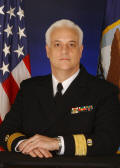
NAVAL RESERVE FLAGpGRAM 06-02
From: Rear Admiral Norton C. Joerg, JAGC, USNR
To: All NavyJudge Advocates and Legalmen serving in the Reserve Component (RC)
Subj: FlagpE-Gram 06-02
Date: 8 February 2006
1. We are already well into the new calendar year. I
hope that everyone enjoyed a wonderful holiday season, and weathered it safely
and well. This year promises to be no less exciting and full of opportunity than
the last, and January, so quickly behind us, brought me confirmation of that
impression in many ways. I will touch on this with you here in this note. But,
before I get to that, first things first, as we turn to:
2. Readiness, Again. As our nation continues its struggle against terrorism, our
Navy will be increasingly called upon to provide a supporting effort to GWOT
missions. For example, a Navy admiral is taking over the supported effort for
Joint Task Force - Horn of Africa and the Navy’s presence on command staffs and
in various joint and combined units, such as civil affairs, customs, and
detention center operation units, is increasing. Therefore, we must remain
vigilant, prepared and ready to respond in whatever role necessary to support
the effort. A great way for all of us to keep abreast of what is happening and
its implications for our futures as an engaged and evolving Reserve Component
community is to read anything and everything you can find about the Quadrennial
Defense Review. The QDR Final Report was released on 3 February. Do some
internet searches on the subject and do some valuable homework. We will see the
effects of the QDR’s far-reaching work as it has an impact on our Navy and our
Armed Forces generally. We do well to stay informed on these “big picture”
issues. Change will challenge us in many ways, but it will also provide
opportunities – a theme to which we return again and again. To realize the
opportunities, we must understand the changes.
Although we discussed readiness in the last FlagpGram,
I want to emphasize it again because it is a vital component of our duty as
reservists – we must be prepared and ready. Commander Navy Reserve Forces
Command (CNRFC) has recently released a P4 to the Force (DTG COMNAVRESFORCOM
221547Z DEC 05) that stresses mobilization readiness. Because the Navy has been
mobilizing a significant number of individual augments to support various GWOT
missions, a disturbing trend has materialized: A 30%, on average, “fallout”
rate. This means that almost one third of Navy Reservists were not prepared and
ready because proper mobilization administration was lacking, including, e.g.,
undocumented or inappropriately addressed changes to medical or dental
conditions, problems with the accuracy or completeness of family care plans,
undocumented retirement approvals, etc. Many of the members involved were
recorded as mobilization-ready in our computer databases but, when called upon,
were in fact not ready. Essentially, these recent problematic mobilization
events show that our databases are only as good as the entries made into them.
Members and their chains of command are not tracking mob issues to keep
readiness up to date. We have to do better, and I expect all of us to pay
attention to the details involved.
CNRFC requires that each unit commanding officer work up and down his or her
chain to improve mob readiness. Specifically, unit COs are directed to conduct
monthly reviews of their members’ Mobilization Availability Status (MAS) codes
and update them as required. However, with that said, we are all a team and the
COs cannot go it alone. They need our help. We are all responsible for keeping
our chains of command notified of issues that could prevent mobilization. Let
your unit know of mobilization readiness issues and work diligently to fix them.
We must work together and, given the caliber of this community, I know we will.
3. Challenge Equals Opportunity. This phrase will continue to be our guide, and,
given the times in which we live, I cannot see that changing for the foreseeable
future. The best example of this that I have to report now is the status of
funding available to our community for Reserve operational support.
The Opportunity: In a reversal of earlier predictions before the FY06 Defense
budget was finally approved, CNRFC has allocated substantial amounts of Active
Duty for Training (ADT) to the RLP for FY06. The ADT now available is slightly
more than half of our projected need, but more than 4 times the ADT allocated to
the Law Program last FY. This is in addition to the basic Annual Training (AT)
that each of our Selected Reservists are required to perform (absent a waiver)
each year (the familiar 2 weeks of annual active duty), and in addition to the
48 drills each member performs. We will need to bear this in mind as we address
our challenge to plan for and execute on the newly available ADT.
This very positive development is due in large part to the efforts of CAPT
Twining in New Orleans, to our Active Component leaders and fellow members, and
to our Law Program unit COs and regional SJAs, who have worked hard to identify
and quantify real support needs for JAG and Naval Legal Service Command
activities and commands, outside of the basic AT and drills, this FY. We owe all
involved many thanks for ensuring that we have the resources to do our jobs in
support of the mission.
The Challenge, and How to Address It: Because the recent continuing resolution
restricted the expenditure of Reserve funding of any significance for a full
fiscal quarter, we now have less than nine months to execute this increased ADT
allocation, though we, of course, plan and project for a full FY. We must use
these funds effectively and must start executing orders soon to avoid a large
balance late in the FY. We run the risk of having our funds reallocated to
others if we carry a large unobligated balance into the 3d or 4th quarters.
Remember that we have identified needs that exceed even the increased
allocation. On the other hand, if we execute well, it is possible that we will
receive an additional allocation, which will allow us to address a greater
proportion of the demand we have identified.
With this in mind, I expect each one of us, at every level, to work closely with
our Active and Reserve chains of command to identify, prioritize, and plan
specifically for executing our AT, drills, and not least, ADT funds to support
Fleet needs, both within the legal community and outside of it, as soon as
possible. Given that we didn't get the full amount requested, despite the
plus-up, it is entirely possible that not all the support needs identified
earlier can be funded. Even taking this into account, however, please assume
that the newly available ADT will be on hand for many high priority requests,
and please prepare to work with your chains of command to firm things up as to
times and amounts so that we can act on all requests ASAP. Delay serves no good
end: Even if the need for support is not until the 3rd or 4th quarter, if we can
identify the tasks and the officers or LNs to provide the support now, we should
request orders now in order to obligate the funding. Of course, as this implies,
the early identification of needs facilitates our timely advertising of them for
the volunteers we need. Time is of the essence, so do your part now.
Of course, doing your part may include, when the time comes and opportunities
are advertised, stepping forward to provide the needed support itself. I
encourage you to watch all of our avenues of communication – e-mail, the web
site, your chains of commands’ communications resources, and so on – so that you
can know of and act upon all opportunities for which you are qualified and
available to serve. We will need many of you to meet our “demand signal”.
The process is simple for everyone: CAPT Joe Twining, SJA to CNRFC and our Law
Program Manager, should receive all requests for ADT support, and all
expressions of interest in them, ASAP via the appropriate chain of command and
per the relevant announcements of opportunities. He is at
joseph.twining@navy.mil and
504-678-5180, DSN 678-5180. Your local RLP COs, SJAs, and Senior Enlisted
members can, of course, assist. Another outstanding resource is CDR Ingrid
Turner, who supports me as OJAG Reserve Program Division Director (Code 62). She
is at 202-685-5216 (DSN 325) or
ingrid.turner@navy.mil.
The Challenge’s Significance and Implications: All of the foregoing may seem to
some to be a "reversal of fortune" compared to the situation we thought we were
going to face this FY, when we were looking at a 60% cut in ADT funding
year-over-year. From one perspective, it is indeed such a reversal -- but it
will be anything but if we don't execute on our projections. Our performance
here will have a direct bearing on our efforts to continue to get our proper
share of operational support dollars in the years, not to mention the months,
ahead. In other words, our future capacity to serve will hinge in a significant
way on our ability to turn to on this challenge, every day, all year, and into
the future. I am counting on you – and feel very strongly that this confidence
is well-placed.
4. Military Law Training Symposia. We are using a new format for the MLTSs this
year. Just as ADT funding overall for the Navy Reserve is less than last year,
IDTT funding (which supports travel for off-site drills) is also less than last
year, and, unlike the case with our ADT, our access to IDTT funds sufficient to
support attendance at MLTSs will probably remain seriously constrained. As a
result, we determined that we needed to go to a more distributed schedule of
symposia with an emphasis on local meetings oriented to members’ states of
residence, rather than to functional or unit affiliations. Accordingly, the
MLTSs are not mandatory this year but attendance is very strongly encouraged.
This approach will help us save on travel costs paid through IDTT which will
allow us to keep our operational support capacity robust. This new format will
also afford me an opportunity to visit more regions so that I may learn more
about local needs and successes. I believe that many benefits will flow from
that. I look forward to the trips and to meeting in a dialogue with many of you.
Right now, we are planning 6 MLTSs, in Newport, Norfolk, Great Lakes, Orlando,
San Diego, and Dallas. Attendance will be strictly controlled by region, so
please don’t plan to “forum-shop” in connection with preferences for certain
locations or in connection with other plans, personal or official.
Please check the MLTS information page on this web site for much more detail
regarding the locations, times, and registration for the distributed MLTSs.
Please be sure to return to check the web site for developments frequently, as
final arrangements, including whether we will indeed conduct MLTSs at all the
locations currently contemplated, will be announced in March. Checking weekly,
or even bi-weekly, would not be checking too often, as the situation remains
somewhat fluid.
5. Final Thoughts. To conclude this FlagpGram,
I want to pass along my very great appreciation for the job that each of you do,
as always. I know the work can be difficult, time consuming, and, at times,
stressful or very dry. Every one of you is, nevertheless, making a difference to
our nation, no matter what billet you fill. I know that we, and others, can
sometimes take our important role for granted and so fail to appreciate its
significance, especially when we are doing what seem to be rote or repetitive
tasks far from the drama and excitement of what appear to be the front lines of
the battle. Remember, however, that the Global War Against Terror is, to use
DoD’s new, and apt, characterization, the Long War. There is a premium on
staying the course, in doing our bit, in understanding that this war, unlike any
other, can insinuate itself into every aspect of life – sometimes most
violently, unexpectedly and uncomfortably close to home. In other words, the
front lines are fluid and indistinct. These days, especially, public service,
particularly in the cause of our nation’s security, is no small thing. We should
all take great pride and satisfaction in it.
With this in mind, you should also know that you are making a difference in the
lives of our individual Sailors, Marines, and Coast Guardsmen (and, for many of
us, Soldiers and Airmen too). As an example of this, I note a quote from a
Washington Post article about increased reenlistments. The soldier quoted had
recently reenlisted in Iraq even though wounded. After discussing his ability to
use his marksmanship talents, he said he reenlisted because "[t]he pay is
decent, you have benefits, they help you with legal problems. It's kind of like
having a big brother watching out for you all the time." (See, GIs In Iraq
Choosing to Re-Up, Ann Scott Tyson, Washington Post, Sunday, December 18, 2005)
“They help you with legal problems” – they are, very often, you. Our uniformed
legal community, writ large across the services -- of which we in the Navy’s
Reserve Law Program together form a very significant part -- is a major reason
this soldier wanted to continue to serve our nation. You can be sure that his
sentiment is duplicated many times over.
What we do matters. Many, many thanks again for dedicating yourselves, in big
ways and small, to the cause of security and freedom!
All the best!
-- Norton Joerg